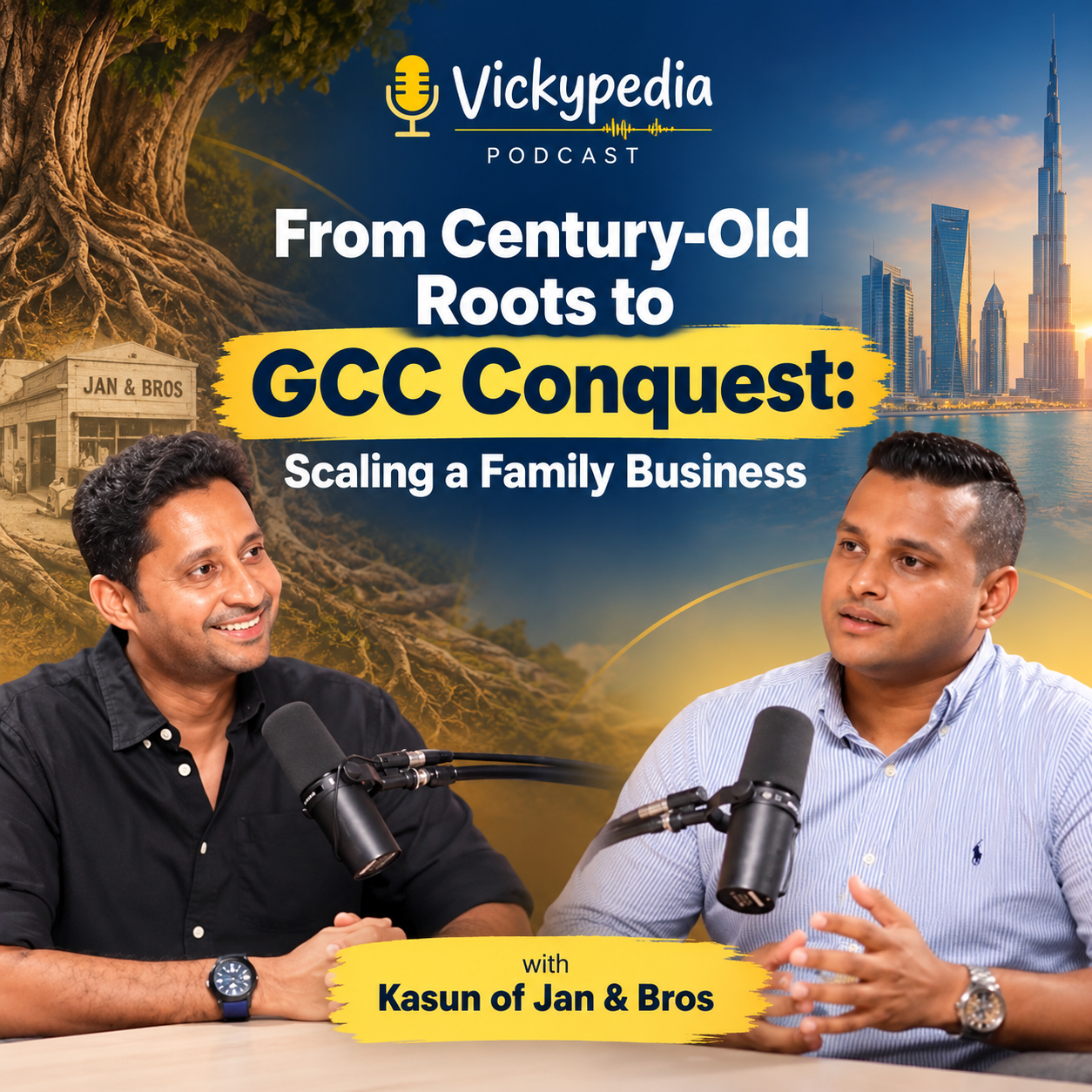
Episode Transcript
[00:00:00] Speaker A: We've been in this business for the last four generations and also always taking the side of a consumer in whatever the product category we operate in. So that was what was working for Jaan and Brothers for the last hundred years and sixty years here in Dubai. The transformation we are looking at is to go and become one of the largest FMCG companies in the world while we stick to the true values of always keeping the customers the forefront and the core of our business to the consumers. Your supply chain and your logistics and your procurement has to be the core of your business. You can't scale up a business without having the right people.
A company should always choose to invest in the right people. I want people to be accountable and I want people under me to grow because I don't want a single person stagnant in the same position because that's wrong. You know, I have to look after people, I have to look after their careers and I have to look after their families. After Covid, the traditional decision making no longer applies to the world. You are in a mindset called agile leadership. Oh, first mistake. I think a lot of companies do. They think what works in your home country works for you in the new market.
That's absolute chaos. You need to understand what do the consumers in GCC truly wants from your brand.
Don't try to push a product that is out of the world that is, you know, working for you well in your country down the throats of like the consumers here. It doesn't work. You have to understand you are in one of the world's biggest trading markets which means you will get access to thousand other products that probably offer better pricing for the consumer, probably even a better formulation or better product proposition.
The simple advice I give to any person who wants to establish their brand here. You need to have a minimum patience of three years.
Word in any business is relationships. Jaan and Brothers is a business that has been built over trust and that is non negotiable for us.
[00:02:08] Speaker B: Hello and welcome to Wikipedia. My guest today has built his career launching brands in 20 countries.
He is a general manager of a company which started in 1930 and owns one of UAE's number one hair color brand Henna Speedy. From media presenter to Sri Lankan national hockey player and now a business strategist. Please welcome Kasun Seguera. Kasun.
[00:02:32] Speaker A: Hi. Hi. And thank you so much for having me Vicky. Well, it's a pleasure and I'm looking forward to having a great conversation.
[00:02:38] Speaker B: Absolutely. Kasoon, Looking forward. I must ask you, Kasun Jaan and Bros. Started in 1967, the parent company in 1930.
[00:02:48] Speaker A: Absolutely.
[00:02:48] Speaker B: That's almost 100 years. So you transformed a family legacy into a corporate entity. Let's start by asking you one thing you had to break to grow and things that you had to change.
[00:03:01] Speaker A: Well, it's been a roller coaster, right.
Because as you very, very much know in a management context we call family owned companies like these as legacy companies.
So when you are managing a legacy company there are a lot of emotions attached to a business. There is a lot of decisions and pre owned legacies especially we've been in this business for the last four generations.
So there is a human that has been passed down in generations certain values, certain principles and certain knowledge which worked out in the times that some of the owners and some of the operatives, you know, have applied during that time. So there's a lot of pass down knowledge.
So one thing I made sure I follow is I always wanted to keep the the DNA within the company which was about being aggressive, which was being a fast to market and also always taking the side of a consumer in whatever the product category we operate in. So that was what was working for Jaan and Brothers for the last hundred years and sixty years here in Dubai almost. We have always taken the customer, the customer needs and the consumer demands and consumer value, value creation actually as the core of our business. And that was something I refused to change when I took over the business. But of course converting the business into a cor corporate setup, it's not going to be a product, it's not going to be something that you can do overnight.
So that change management is something that I had to strategize and obviously building teams who can run the business and where we can scale up the business in a organic manner and look at the horizons that we operate like in a much more larger level.
So understanding that broader picture while making sure that I stick to the values of the founders and what is working for us in our DNA, in the company, keeping it all together while being aggressive and while protecting and ensuring the values of the consumers that we operate with. Combining all of this into one strategy is something that I refuse to give up on. And yeah, so the transformation we are looking at is to go and become one of the largest FMCG companies in the world while we stick to the true values of always keeping the customer as the forefront and the core of our business.
[00:05:48] Speaker B: So you did mention that you did certain changes in terms of adding some departments, probably subtracting some departments and let's Go a little deeper to understand. What exactly did you do?
[00:06:00] Speaker A: I think first I had to understand the business, how the business was currently operating, and what was the status quo of the current business compared to. To the best practices globally. Right.
Especially if you are working in fmcg, your supply chain and procurement has to be the core of your function as a company. We only work with the world's best. So first of all, I think I had to learn about the business while unlearning whatever I knew, because it's very important for you to understand the core of the business.
And then I took my own time taking a deep dive into each function. How does our finance work, how does our procurement work, how does our supply chain work, how does our marketing work, how does our brand building work? And how does our NPD cycles work? So I had to get into the depth of all of these elements. And one thing that was very important for me, especially with my accumulated knowledge in fmcg, is that if you are to work with FMCG and if you are to be competitive and to give something substantially of value to the consumers, your supply chain and your logistics and your procurement has to be the core of your business.
Any company who doesn't have an understanding about the relationships you have with your suppliers, your manufacturers, I think that's a recipe for disaster.
So for me, strengthening our relationships, strengthening our manufacturing, strengthening how and what kind of products do we want to, and what kind of categories do we want to operate, putting that all into sync was a very important part of my initial journey. And then also making sure that we have the right people running the business. That is the most important part. You can't scale up a business without having the right people.
A company should always choose to invest in the right people.
So I had the task of, you know, essentially talking to almost like 70 staff members across different. And some of them are older than me, some of their working time in our company is older than my age.
So, you know, trying to learn from what they have seen, what are their feedbacks and what kind of change they would like to have. Especially I've been in the company only for last two and a half years. So coming into a company, I wanted them to accept and be a part of the change that I'm going to do, rather than them feeling alienated in this change. So it was very important for me to understand people as a second point, understanding the business, the core elements, and then the people. And then the third and most important part is I am someone who likes to have a structured approach to business, who likes to have clear boundaries for people to operate in, give clarity for people. These are your responsibilities. And I want people to be accountable. And I want people under me to grow because I don't want a single person stagnant in the same position because that's wrong.
I have to look after people, I have to look after their careers, and I have to look after their families. So understanding those elements are very important for me in the business.
Then once I put this structure in place, I individually sat with all of these department heads, gave them an absolute blank sheet, initially saying, yes, you have been doing this job for the last few years, but this is how we are going to operate now.
These are what you're supposed to do. And obviously within that, you're free to make your own decisions. I gave a lot of power for people to make their own decisions. And even if they make mistake, I've always told them, look, it's okay. You make a mistake, I'm there behind you to back it up. So I gave them the power of making decisions because that's the only way you can scale up a business. If you try to micromanage as a leader, that's again, a huge, huge recipe for disaster.
So I think the principle of how I operated was very simple in summarizing this. First, understanding and protecting the core of our business.
Second is making sure that I look after the people that are working with me and also understanding their needs and their growth and their careers. Third is, I think, putting a proper structure to the business after understanding all of those two elements before, and giving proper accountability and power to make decisions for my subordinates who can actually make their own decisions. And that will be helping me to make faster decisions. And the fourth most important thing, I think that was my trump card.
If you look at the last few months, seeing everything that is happening in the world, I refuse to have a structured organization that slows down us.
[00:11:13] Speaker C: Okay, Right.
[00:11:15] Speaker A: Because if you are in fmcg, you need to be very, very fast in decision making.
And I think after Covid, the traditional decision making no longer applies to the world. You are in a mindset called agile leadership, where every day that you wake up, something would have changed in the world. So that means you need to have a fresh mind, fresh perspective, and to make a decision without having much emotions, emotional attachment into it. A lot of companies and a lot of leaders, they refuse to change because of emotional baggage. They think, no, I have done this to the company, so I need to wait, wait, wait. And probably they Wait for many years losing a lot of money, losing a lot of people and making terrible business mistakes. That is because they are emotionally attached to the decision. But I think in my principle it's different.
Yes, we make a decision which was the best at that point, but today it might not be relevant. So you need to change it. So agile leadership is the core of how I look at in my business.
That's my fourth and the most important pillar, how I drive this business right now.
[00:12:21] Speaker C: That's brilliant. You know, out of all these four, I love the second point where you're taking care of people and that's what probably has, you know, gotten you to different parts of the world to experience and to launch brands all over the world as well.
A lot of companies, I'm sure a lot of brand owners, let's say from Sri Lanka or from India, some brand owners, they want to enter the GCC market. What would you suggest? Three expensive mistakes that they can avoid when they enter GCC markets.
[00:12:51] Speaker A: So I think at John Brothers we get like requests from many brand owners worldwide. They're asking whether are you interested in taking distributorship for Gulf?
The first thing I would obviously, with all due respect ask is are you willing to leave every knowledge that you have, every little thing that is working for you in that market at the airport when you come here? That's the first question I asked. Because every market works very, very differently.
[00:13:23] Speaker B: Okay?
[00:13:24] Speaker A: Yes. There can be certain elements that are unique to your brand that might be having a core unique element that probably is working for you in that market. But it doesn't mean that Xagra CP is going to work for you in another market.
So as long as if you're not willing to learn the new way of doing business in that new market, that's again is asking, that is again you asking for a lot of trouble there in the new market.
So I think first point or first mistake, I think a lot of companies do they think what works in your home country works for you in the new market.
That's absolute chaos. It doesn't work.
This market operates very, very differently.
FMCG categories work very differently in the Gulf.
[00:14:16] Speaker B: Even though these are common products which are used around the world, still it works different.
[00:14:21] Speaker A: It works differently because you need to understand how the modern trade, down trade and the traditional trade works here. Right? You have to understand how you push a product through. Modern trade is very, very, very different. How you would push it through the downtrend here. Right. And how does, like how are you planning to cater it in the seven different Emirates. Right. The structures are going to be different. Right. And then if you, I mean we are just talking about uae but. Right.
All the modern trade partners that are in these seven different Emirates. Right. And the A grades, the B grades, the C grades, all of them are unique to each other.
Right. So if you don't know it, you're asking for a very expensive failure. That's first point. Second thing that I think is very important is you need to understand what do the consumers in GCC truly wants from your brand.
Don't try to push a product that is out of the world, that is working for you. Well in your country down the throats of the consumers here it doesn't work.
Understand how does the consumer behavior works here? What taste palettes? If you're looking at food, if you're looking at let's say oral care categories, understand what are the taste buds and taste palettes that works here.
Understand what kind of packaging works here, what kind of price points that work here. Right. You have to understand you are in one of the world's biggest trading markets, which means you will get access to thousand other products that probably offer better pricing for the consumer, probably even a better formulation or better product proposition. So you have to get a deep dive into the consumer preferences. That's the second point.
And because if you don't do that, if you don't do that, you will spend a lot of money trying to market the product and you will do a lot of listings, you will do a lot of lot more. Well, you will lose a lot of money.
And the third and the most important point, do not just become a trader in this market.
Be a person who develops a brand.
The moment you become a trader. Yes, today you will maybe sell one or two containers and you'll be very happy. But down the line you will realize that there are 10 other brands who are doing the exact same who are probably offering a better pricing than your brand and well, the consumers will shift. Because you have never created noise and you have never created a value proposition for your brand.
Don't do just trading, build your brand and you have to have a lot of patience behind it.
Well, the simple advice I give to any person who wants to establish their brand here, you need to have a minimum patience of three years.
[00:17:15] Speaker B: Wow.
[00:17:16] Speaker A: You need to be able to unlearn and learn and then obviously have a P L that might not look so fancy and very lucrative for you.
[00:17:26] Speaker B: So three years is like the testing minimum.
[00:17:29] Speaker C: And then you can probably.
[00:17:32] Speaker A: And also in that three years Vicky, it's very important for you to do what is right by your brand.
You have to make sure consumers know about your brand.
Why would a consumer pick the product off the shelf if it's unknown? They will always stick to the brand that they know.
So that's very important.
So that's an advice I would like to pass on to anyone who wants to enter gcc. Look, if you have an interesting product, we are very open. We are a very, we're a company that is open and who are willing to work on long term partnerships. That's an important part of our philosophy. We don't do short term partnerships and we don't do trading. We are looking for long term partners. Who wants to enter and win. Gulf in my philosophy I want to build brands under John Brothers for the future, right? So if you have the same vision and if you're willing to invest behind your brand and if you have the patience for three years and if you're willing to change what you know in that market and to do what is right by your brand for the right, what is right by the consumers in this market. Well, let's talk.
[00:18:40] Speaker C: Fantastic, Fantastic. In fact the three points that you mentioned is one, if you're willing to unlearn and things that worked for you in your market when you enter here, you should be coming up fresh. The other is know your consumer, do proper research. And the third one is the last point that you mentioned.
Patience, patience, three years waiting time.
Excellent points.
Let's move to a fun part where you started as a media presenter. You got an award as well.
General manager. So what do you think in Dubai what's more important to close a deal? Is it strategy or is it networking?
[00:19:15] Speaker A: I think the golden word in any business is relationships.
That is non negotiable.
[00:19:25] Speaker C: Right?
[00:19:26] Speaker A: Whether you're a supplier, whether you are a brand owner, whether you're a, how to say, just a trader.
Relationships is what will make sure that you are successful.
So networking, I mean as, as it's, as, as it is like probably now a bus sentence.
Your network is your net worth. I think I've heard a lot of people like say this, it is very relevant.
Actually it's not relevant. It's a survival skill in this market. If you don't network, you're out as a business. If you don't network as a profession, professional, you don't network, you're out. You are far, far, far behind the scenes of how the markets operate. You need to sit at the right tables with the right people, talk to them, learn from them and obviously pass down the knowledge that you have. Because the world, you literally have the entire world for you to grasp because you are in such a, such an amazing place in the world where you connect east to west and west to east, right? You're right in the middle. So it's very important for you to learn from what is happening elsewhere in the world and try to bring those best practices, best products into these markets.
So networking is very important.
And I have seen a lot of people who post on social media, they come and say you need to go and network. And then the moment you actually ask whether do they actually network, what do they do? They say, no, I text people. I have WhatsApp conversations with people. No, have in person conversations. Go out there, talk to people. You will learn a lot. And what you learn is what you will bring to your table when you are a decision maker.
Because majority of the business, I mean majority of the traditional businesses, they try to do what has worked for them over generations. Look, we are in a situation where today in the morning, I see one news, by the evening, probably there's another development out of it, right? So that means that can be the same in your business and that is the same principle in your business today. The competitor, you think that's going to overtake you, right? That the competitor that you had in mind when you woke up probably might be different when you are down in, when you're waking up, when you're going to bed in the evening. So I think it's very important for us to have the right network, keep on talking to people.
I'm a big believer your biggest opportunity will be sometimes one conversation away.
It's very, very important.
You might speak to like thousand people, right? But all it takes is one good conversation to change your life and change your business.
[00:22:15] Speaker B: Fantastic. Kasun. You know, it was lovely learning so
[00:22:20] Speaker C: many things from you.
[00:22:21] Speaker B: But before we let you go, one final question about Jaan and Brose.
There's a lot of products and I'm sure that, you know, you are fond of every product but one product probably you use every day or you know, has become a part of you.
[00:22:38] Speaker C: From the catalog of Jarnan Bros. Oh,
[00:22:40] Speaker A: I think like we have some fantastic brands like Henna, Speedy, Concord, Skinmat.
So I think the product that I been very recently associated the most and what I love the most is we have launched this, a new skincare product called Skin Mate. It's a brand that obviously works around some of the very highly productive ingredients worldwide.
So developing this brand has been something that I've taken a lot of fun with because it's, I mean it's one of the most difficult categories to penetrate to. You have so many multinational players and everything. But look, testing those products and knowing that this product is just brilliant and the price point that we offer it to consumers is going to disrupt a lot of businesses and multinationals. It has given me a lot of joy. And obviously in the beauty world this year we will be launching these products.
So we have launched this fantastic product range with collagen, vitamin C, hyaluronic acid and retinol as the core ingredients. And there's a lot of great products. Well, we have a consumer, I mean we have a consumer product range for anyone just about 16 years of age to anyone who's even probably 60, 70 years of age.
So developing this range and it's a product range I personally use. I get like my friends to use, I get my family to use. So one thing I believe in is a product that I can't put on myself, I can't wear, I can't use, I will never push it to the market.
It's very simple, simple as that. Because Jaan and Brothers is a business that has been built over trust and that is non negotiable for us. Trust our relationship to consumers and also giving it at an affordable price.
Our philosophy, my vision for the business is actually bringing the world's best products, personal care products, FMCG products, bringing the world's best products at a very affordable price point for consumers.
We don't work in the cheapest categories. No, we are not commodity traders.
But also we bring great premium skincare products, cosmetic products, household products at a very, very affordable pricing. So in answering your last question, skinmate, it's a brand that you should go and do search for.
You will be probably surprised by the price points we work at.
But one thing is the products inside that those, I mean the products and the formulations, they are the best in the world and they are some of the best products that you will get at that price point and it will definitely work. Well, I'm on LinkedIn. Please reach out to me if you have any feedback about our products. We are a company that truly loves to listen. Reach out to us. We are here to talk, we are here to support and well, if you want to be a part of part of our journey, do reach out to us. Well, I'm someone who looks for great talents always, right. And I want a team that is who's also looking out to grow and conquer the world in our journey. So we are open for people right? And we are someone who really believes in having the right people doing the right things for us and also having the right products that does what is absolutely right and brilliant for the consumers.
So simple as that. Well, if you are serious about business, let's talk. If you are serious about networking, let's talk. And if you're serious about growth and entering in gcc, let's talk.
[00:26:23] Speaker C: Brilliant. Kasoon, it was a pleasure having you on the show today and there were so many valuable insights to learn and there are so many things that we are looking forward from Jaan and Brose, you're doing brilliant. Keep up the great work and thank you so much.
[00:26:36] Speaker A: Thank you so much for having me. Vicky, it's been an absolute pleasure.
[00:26:39] Speaker C: I hope you enjoyed watching this episode and if you did please do like share comment and keep it on on Wikipedia because there'll be more videos coming out soon. Thank you.